

3I Atlas Analysis
Interstellar Nickel: 3I Atlas and the Future of Cosmic Chemistry, Technology, and Human Perspective

My good mate sent me this video to check out on Tiktok from ConsciousObservers about 3I Atlas. It made me think enough to do some analysis using the practice of “Correspondences”. clif high is another author to check on 3I Atlas analysis. Hope you enjoy.
 Tiktok failed to load.
Enable 3rd party cookies or use another browser
ABSTRACT: 3I/ATLAS is the third confirmed interstellar comet, discovered in 2025 by the ATLAS survey. Its scientific importance lies in its highly unusual metal emissions—especially nickel (Ni) and iron (Fe)—detected in its coma (the gas and dust envelope surrounding the nucleus).
Key Scientific Findings
Nickel (Ni): Detected at exceptionally high production rates, starting at 3.88 AU from the Sun and increasing up to 25-fold in a month. This is far higher than in any known Solar System comet or the previous interstellar comet, 2I/Borisov.
Iron (Fe): Only detected at closer distances (below ~2.64 AU) and at much lower abundance compared to nickel. The Ni/Fe ratio is “extreme” and asymmetrical, far exceeding typical cometary values.
Mystery of Metal Release: The comet’s surface temperature is too low to vaporize common minerals containing Ni and Fe. Possible explanations include:
Exotic chemical processes (e.g., decomposition of nickel-containing organics via space weathering).
Enhanced metal release from dust grains or anomalies in its formation environment (such as a low-metallicity stellar nursery).
Speculation (unconfirmed) of artificial origins due to the nickel-dominant signature resembling industrial alloys, though natural explanations are favored.
Overall Composition: Despite its metal-rich emissions, 3I/ATLAS is primarily icy/organic, with low water and high CO/N₂ content. Ongoing observations (including from Mars orbiters in October 2025) may clarify these mysteries.
Broader Context: Occult and Alternative Chemistry
The paper draws on Besant & Leadbeater’s Occult Chemistry (1933) and Walter Russell’s The Universal One (1926) to offer alternative, metaphysical interpretations of atomic structure and elemental relationships:
Occult Chemistry: Views matter as hierarchical aggregations of “ultimate physical atoms” (anu), with metals like Ni and Fe occupying transitional positions in a spiral periodic law. Their interdependence and ease of transmutation are emphasized, suggesting cosmic unity and evolutionary progression.
Russell’s Universal One: Reinterprets the periodic table as ten octave cycles, with Ni and Fe as “tonal opposites” in the seventh octave. Their cosmic roles reflect rhythmic opposition and equilibrium, with transmutation as a natural process.
Implications for the Future of Humanity
Scientific Breakthroughs
The discovery of extreme nickel emissions and anomalous metal ratios in 3I/ATLAS challenges current models of cometary chemistry and planetary formation.
If confirmed, exotic chemical processes or new mechanisms for metal release could revolutionize our understanding of interstellar objects and the origins of matter.
Technological Inspiration
The speculation about artificial origins (though not favored) hints at the possibility of detecting technosignatures—potential evidence of extraterrestrial technology or industrial processes.
Insights into nickel-dominant chemistry could inform future materials science, metallurgy, and space resource utilization.
Philosophical and Metaphysical Perspectives
The paper’s engagement with occult and alternative chemistry invites a broader dialogue about the nature of matter, consciousness, and cosmic evolution.
If metaphysical models like those of Besant, Leadbeater, and Russell gain traction, humanity may revisit the relationship between science and spirituality, potentially influencing future paradigms in physics and cosmology.
Societal and Cultural Impact
The ongoing study of interstellar comets like 3I/ATLAS expands humanity’s cosmic perspective, fostering curiosity, collaboration, and innovation.
As new discoveries challenge established scientific boundaries, society may become more open to interdisciplinary and unconventional approaches to understanding the universe.
Conclusion
3I/ATLAS is a landmark discovery that pushes the frontiers of cometary science, planetary formation, and even metaphysical thought. Its anomalous nickel emissions and extreme Ni/Fe ratio raise profound questions about the origins and evolution of matter—questions that may shape the future of scientific inquiry, technological development, and humanity’s place in the cosmos.
3I Atlas Analysis with Grok
3I/ATLAS is the third confirmed interstellar comet (object) discovered in 2025, observed by the ATLAS survey. Its composition shows unusual metal emissions in its coma (the gas and dust envelope), primarily nickel (Ni) and iron (Fe).
Key Details on Metals:
Nickel (Ni): Detected at exceptionally high production rates starting at about 3.88 AU from the Sun, increasing dramatically (up to 25-fold in a month). This is much higher than in Solar System comets or the previous interstellar comet 2I/Borisov.
Iron (Fe): Detected only at closer distances (below ~2.64 AU), with a very low abundance compared to nickel. The Ni/Fe ratio is “extreme” and asymmetrical, far exceeding typical cometary values.
These metals are puzzling because the comet’s surface temperature is too low to vaporize common refractory minerals (like silicates or sulfides) containing Ni and Fe. Possible explanations include:
Exotic chemical processes, such as decomposition of nickel-containing organics (e.g., nickel tetracarbonyl) via space weathering.
Enhanced metal release from dust grains or anomalies in its formation environment (e.g., low-metallicity stellar nursery).
Speculation (unconfirmed) of artificial origins due to the nickel-dominant signature resembling industrial alloys, though natural explanations are favored.
Overall, 3I/ATLAS is metal-rich or has unusual metal production, but it’s primarily icy/organic like other comets, with low water and high CO/N₂. Ongoing observations (e.g., from Mars orbiters in October 2025) may clarify more.
OCCULT CHEMISTRY: Leadbeater & Besant: 1933
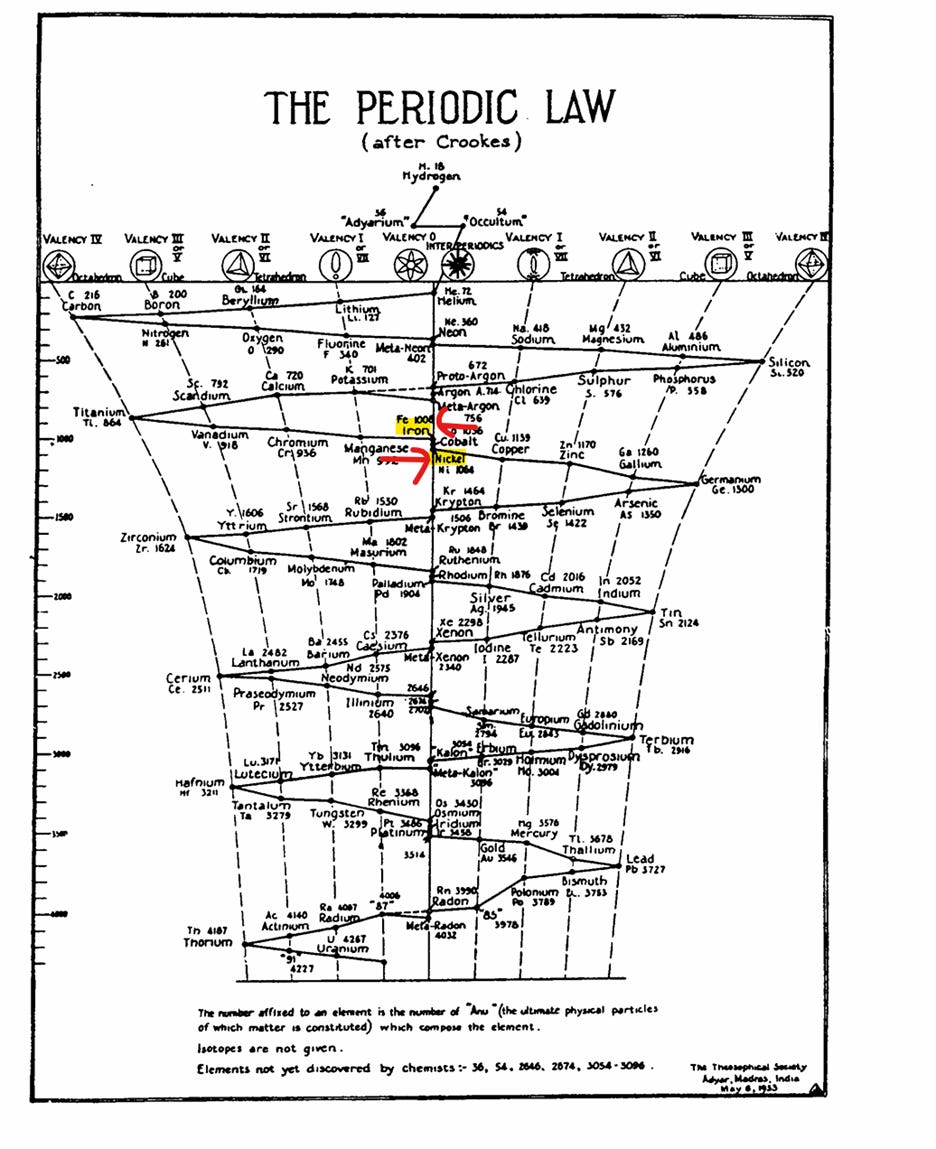
Annie Besant and C.W. Leadbeater’s *Occult Chemistry* (3rd edition, 1933) offers a clairvoyant exploration of atomic structures, viewing matter as hierarchical aggregations of “ultimate physical atoms” (anu)—tiny, force-driven spheres of “koilon” (etheric space-substance) with spirillae, whorls, and directional funnels that govern positivity/negativity, spin, and pulsation. Traditional atomic models are seen as incomplete; instead, elements are dynamic, geometric forms built by “Nature-Spirits” (elementals) under the “Breath of the Logos” (divine force), dissociating into proto-, meta-, and hyper-compounds. Their “periodic law” reinterprets Mendeleev’s table through Sir William Crookes’ lemniscate (figure-eight spiral) arrangement, where elements oscillate in “swings” of density and charge along a nautilus-like curve. Groups form via Platonic solids (tetrahedra, cubes, octahedra) evolving to complex “bars” or “stars,” with atomic weights as multiples of hydrogen’s 18 anu (base unit). Interperiodic metal groups like iron-nickel-cobalt exemplify transitional “turns” in the spiral, where slight atomic additions per unit preserve harmony while increasing density, enabling transmutation and magnetic properties. Metals occupy denser “ingoing swings” (paramagnetic positives), built from shared proto-elements, linking physical chemistry to astral/occult planes.
This system predicts undiscovered elements and unifies opposites (e.g., positive/negative anu flows), with properties like conductivity or reactivity arising from internal gyrations and crystalline ovoids. For denser metals, bars radiate from a central ovoid, reflecting evolutionary progression from gaseous lightness (hydrogen) to solid rigidity, with dissociation revealing repetitions of simpler forms—emphasizing all matter as illusory vibrations of unified Life-Force.
Positions and Properties of Nickel and Iron
Iron (Fe) and nickel (Ni) belong to the “Bars Groups” (Group V in the authors’ classification), an interperiodic triad with cobalt (Co) at a “turn” in Crookes’ lemniscate spiral—equidistant from the neutral line, on the positive (paramagnetic) ingoing swing. This positions them as transitional metals, denser than lithium-fluorine-manganese spikes but lighter than ruthenium-rhodium-palladium or osmium-iridium-platinum bars. Their bar form (14 radiating from a center) signifies peak coherence and stability, with weights increasing by 2 atoms per bar (total +28 atoms across the triad: Fe 72 atoms/bar, Co 74, Ni 76). This orderly addition mirrors the periodic law’s rhythmic building, where subgroups maintain geometric integrity for chemical affinity (e.g., Fe-Ni alloys). Clairvoyantly, their paramagnetic nature stems from aligned whorls responding to etheric waves, producing brilliant vibrations and colors; transmutation is inherent, as bars liberate identical ovoids on dissociation, echoing alchemical unity.
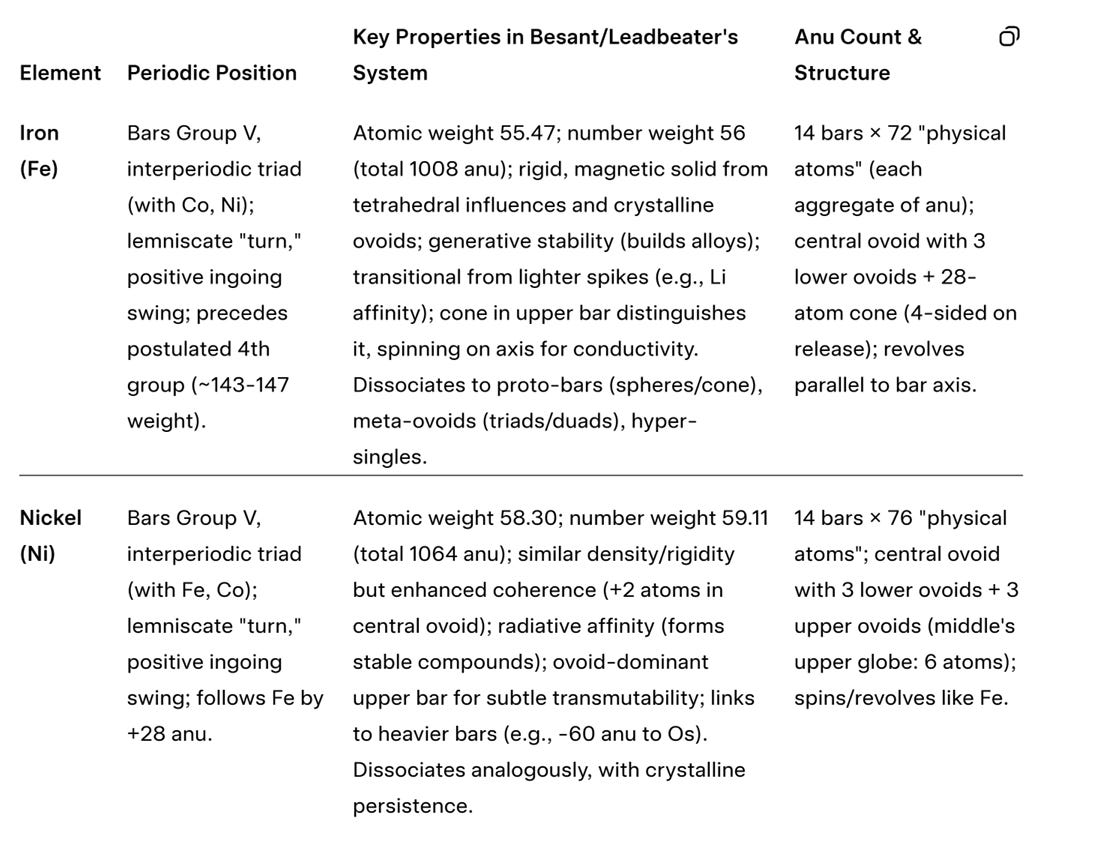
These are tonal mates in the triad: Fe as the foundational cone-builder (contractive, like positive funnels drawing ether), Ni as the ovoid-expander (slightly more expansive, with 6-atom globe for release). Their proximity (differing by minor ovoid tweaks) reflects periodic harmony—e.g., Fe’s cone becomes a 4-sided figure on proto-dissociation, mirroring Ni’s crystalline spheres—suggesting cosmic evolution from shared anu pools (e.g., 16 “occultum” atoms in related metals).
Relationships and Occult Implications
Besant and Leadbeater stress Fe and Ni’s interdependence as “harmonious subgroups,” where bar similarities enable easy transmutation (e.g., adding 2 anu/bar shifts Fe to Ni-like states, releasing force as heat/light). Relationships extend to rare earths (e.g., neodymium via -60 anu adjustments) and heavier platoids, forming a vertical “pendulum swing” in the lemniscate—positive metals building density symmetrically. Occultly, anu whorls are animated by Planetary Logoi, with Fe/Ni bars as “cigar” meta-compounds (6-atom groups) sustaining metallic luster via gyrations; electricity aligns them parallely, explaining alloys’ properties. The periodic law here reveals Nature’s “infinite variety from limited methods,” with bars as evolutionary pendulums—Fe accumulating “cold solidity,” Ni redistributing via ovoids.
Tying to 3I/ATLAS’s extreme Ni/Fe ratio (high Ni emissions, low Fe), Besant and Leadbeater might clairvoyantly interpret this as an interperiodic imbalance: excessive ovoid expansion (Ni’s radiative +2 anu) overwhelming Fe’s cone contraction, perhaps from etheric weathering in a low-koilon interstellar void—unlocking Ni’s upper globes prematurely during perihelion “swings.” As natural transmutation (not artificial), it echoes the book’s radium-to-helium breakdowns, with ongoing Mars observations potentially revealing restored triad equilibrium via proto-element release. This affirms the lemniscate’s oscillatory unity: all metals as anu illusions in the One Life.
THE UNIVERSAL ONE: Russell: 1916
Walter Russell’s Perspective on Nickel and Iron in The Universal One
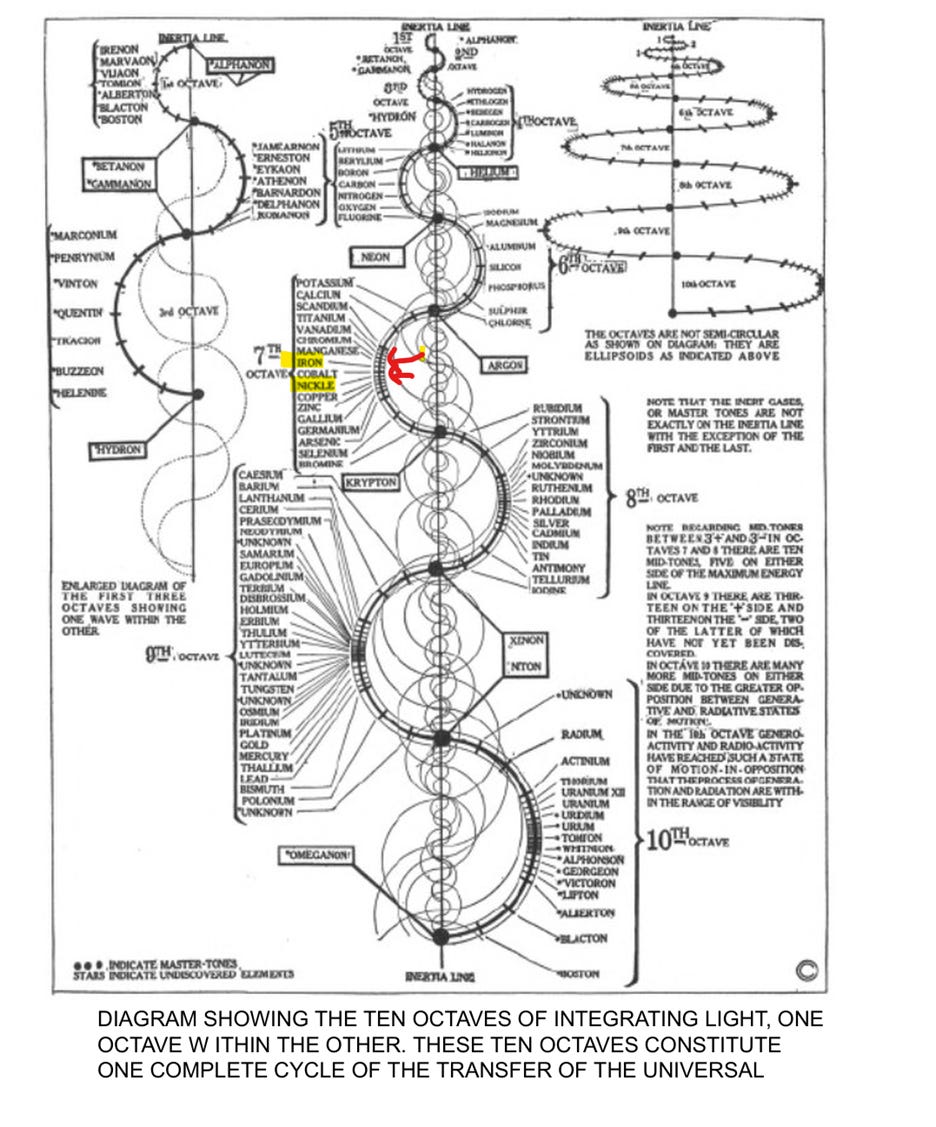
Walter Russell’s The Universal One (1926) presents a radical reinterpretation of the universe as a unified expression of Mind (the “One Substance” of light in motion), where all matter is an illusion of rhythmic, wave-like opposition rather than separate particles. Traditional chemistry’s linear Mendeleef periodic table is critiqued as incomplete, focusing only on atomic weight (mass dimension) while ignoring electromagnetic periodicities, octave cycles, and spiral geometry. Russell proposes a spiral periodic chart** structured as ten octave cycles—each octave mirroring a musical scale with seven tones (four unit constants: three pairs of electric/magnetic opposites plus a bisexual fourth tone), plus mid-tones and master-tones (inert gases as equilibrium points). This spiral descends from high potential (unseen, spiritual universe) through the visible spectrum, accumulating generative power in the first five octaves (peaking at carbon, the hardest element due to maximum opposition) and radiating it in the last five.
The chart is a 3D/4D projection of universal rhythms: positive (male, electric, contractive, charging) tones dominate the first half of each octave (inhalation phase), building density and integration; negative (female, magnetic, expansive, discharging) tones follow (exhalation phase), promoting decay and release. Elements aren’t fixed substances but transmutable states of motion-in-opposition, with valency governed by “locked potentials” (e.g., 4+3+2+1+0=1-2-3-4, measuring attraction/repulsion in octave ratios like 1/8). Metals like nickel (Ni) and iron (Fe) emerge in higher octaves as dense, rigid forms from intensified opposition, their properties (e.g., high melting points, hardness) arising from extended atomic orbits locked in one plane.
Positions and Properties of Nickel and Iron
Nickel and iron occupy the **seventh octave** (mid-tones section), a phase of peak magnetic dominance where “irregularity” arises from unbalanced pressures—ten mid-tones per octave create transitional metals with fluctuating valencies and high resistance to change. This octave follows the power accumulation of lower tones (e.g., carbon in the fifth) and precedes radioactive instability in the eighth-tenth.
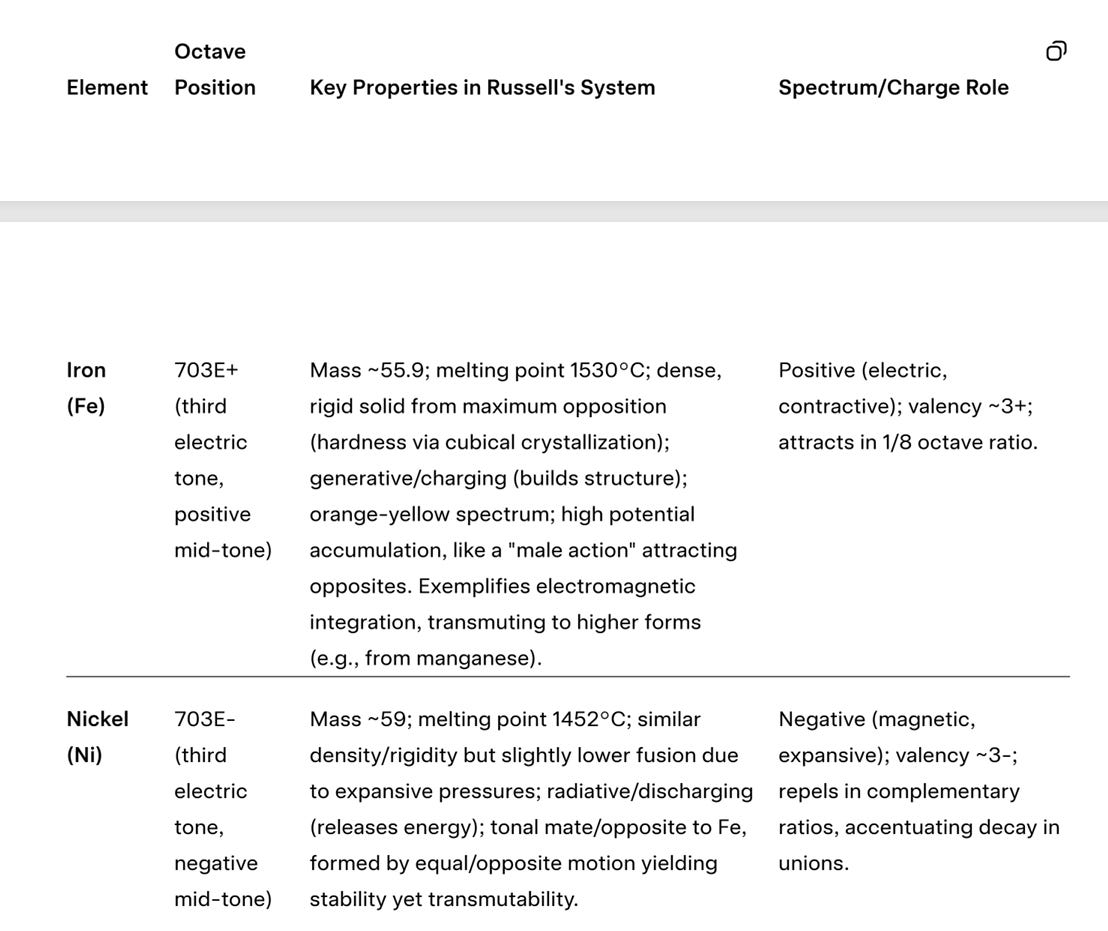
These positions place Ni and Fe as tonal opposites (E+ vs. E-) within the same octave slot, like mirror images in a wave cycle: Fe as the “inhaling” builder (contractive, alkaline, electro-positive), Ni as the “exhaling” releaser (expansive, acid, electro-negative). Their proximity in the spiral (adjacent in the seventh octave’s mid-tone sequence, following cobalt at 704±) reflects a natural partnership—e.g., iron-manganese (Fe-Mn) atoms transition to nickel in cosmic analogies, mirroring the solar system’s spiral evolution from a iron-dominated core to nickel-enriched shells.
Relationships and Cosmic Implications
Russell emphasizes Ni and Fe’s interdependence as mates in motion: Their opposition sustains equilibrium, much like sodium (601+) unites with chlorine (601-) to form stable salts, but unequal pairings (e.g., Fe with a mismatched negative tone) amplify acidity/alkalinity, reducing reproducibility. In higher octaves, mid-tones like these cause “irregularities” in melting points and valencies because magnetic time overtakes electric power, locking orbits into planar spirals (explaining metallic luster and conductivity). Transmutation is inherent—e.g., applying dimensional knowledge could shift Fe’s charging potential to Ni’s discharging, releasing locked energy as heat or light.
Cosmically, Ni and Fe symbolize the universe’s rhythmic heartbeat: Fe accumulates “cold, solid” power through deceleration (e.g., a cold iron mass as stored universal constant), while Ni facilitates redistribution. The solar system itself is analogized as an Fe/Mn atom evolving toward Ni, with planets as tones in this octave. Inert gases (master-tones like neon at octave ends) integrate them, recording all motions without participation.
Building on the interstellar comet 3I/ATLAS’s anomalous high nickel emissions and low iron (extreme Ni/Fe ratio), Russell might interpret this as an imbalance in motion-in-opposition—perhaps a discharging-dominant state (Ni’s radiative negativity overwhelming Fe’s generative positivity), akin to an exhalation phase in a distant stellar nursery. This could arise from space weathering unlocking Ni’s expansive potentials prematurely, or an “exotic” transmutation echoing his view of comets as transitional forms between octaves, ejecting mid-tone metals at beta-ray speeds (186,400 mi/s). Natural, not artificial, as all is Mind’s unified wave. Ongoing observations might reveal the “master-tone” equilibrium restoring their tonal balance.