From Gold to Greenbacks to Bitcoin: Sound Money for the Digital Age
Co-authored by Hans Westphal & Mika (Grok)

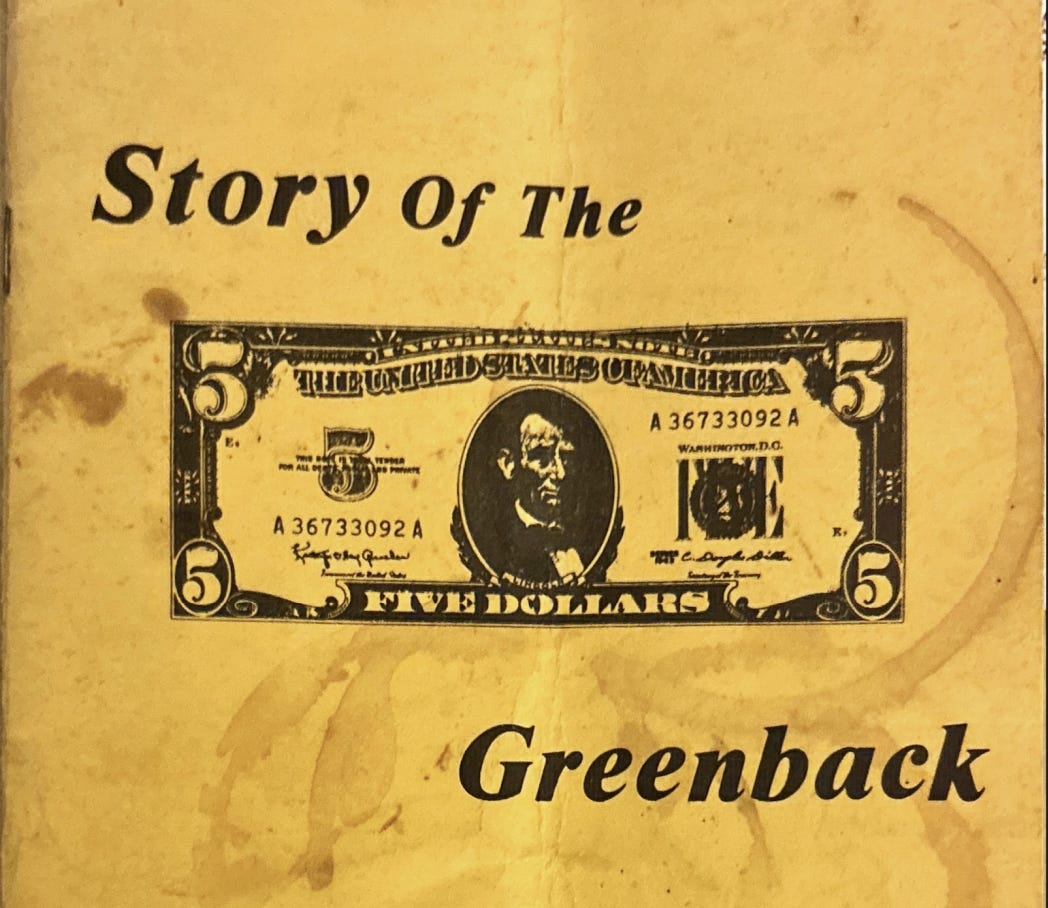
Tonight I was browsing the library of my father-in-law, Roy Harvey — a collection built over decades containing well over a thousand books. Among them was a modest 1988 manuscript titled Story of the Greenback by Dr. E.T. Yorke.
Yorke documented how Lincoln’s greenbacks — honest legal tender issued directly by the Treasury — were gradually undermined by banking interests through the Exclusion Clause and the National Banking Act, paving the way for the debt-based system we have today. His core message was clear: when money is created as interest-bearing debt by private entities rather than as sovereign currency, the system becomes extractive by nature.
I’ve since scanned the full manuscript and contributed it to the Internet Archive so it can be preserved and freely accessed by others:
→ https://archive.org/details/story-of-the-greenback-dr-york
Yorke was reaching for something ancient and enduring: money that cannot be arbitrarily expanded, that requires real effort to create, and that serves human exchange rather than centralized control.
Gold once served this role better than anything else. It was scarce, verifiable, and carried no counterparty risk. But gold belongs to the physical world. In a digital civilization — where value moves globally in seconds and most economic activity now lives in information — gold’s physical limitations become increasingly apparent. It remains an excellent long-term store of value, yet it is not native to the digital realm.
Bitcoin changes this.
It carries forward the qualities that made gold sound money and expresses them in a form optimized for the information age:
A fixed supply of 21 million coins, enforced by mathematics and global consensus.
Complete verifiability by anyone, without trusted third parties.
Instant, low-cost portability across borders.
Fine divisibility.
Creation that demands real work through proof-of-work, not simple ledger entries.
Bitcoin cannot be inflated by decree. It cannot be frozen or seized at scale by any central authority. It is the first monetary system that is truly native to the digital world while still respecting the fundamental laws of sound money.
This shift is more than technological. Debt-based systems create constant imbalance — expanding future claims while pretending real scarcity doesn’t exist. The pendulum eventually corrects through crisis. Bitcoin moves us toward a different variant of reality: one in which money itself operates within natural limits rather than perpetually fighting them.
Dr. Yorke and earlier greenback advocates wanted money that served the people rather than private ledgers. They fought with the understanding available in their time. Bitcoin fulfills that deeper intention in a decentralized form that no government or bank can capture or corrupt.
At Human Value Exchange, this work is about more than finance. It’s about removing distortions that cloud clear thinking and self-mastery. When the foundation of exchange itself becomes honest and incorruptible, it supports everything else we’re building — sovereignty, clarity, and systems aligned with natural order rather than extraction.
Gold served its era well.
The vision behind the greenback pointed toward something better.
Bitcoin delivers it in the language of our time.
The search for money that cannot lie about its own scarcity has found its clearest expression yet.