

Microsoft Copilot Credits, Revisited: Metering AI at Enterprise Scale
This article was co-created with the assistance of Microsoft Copilot, Grok & Gemini.

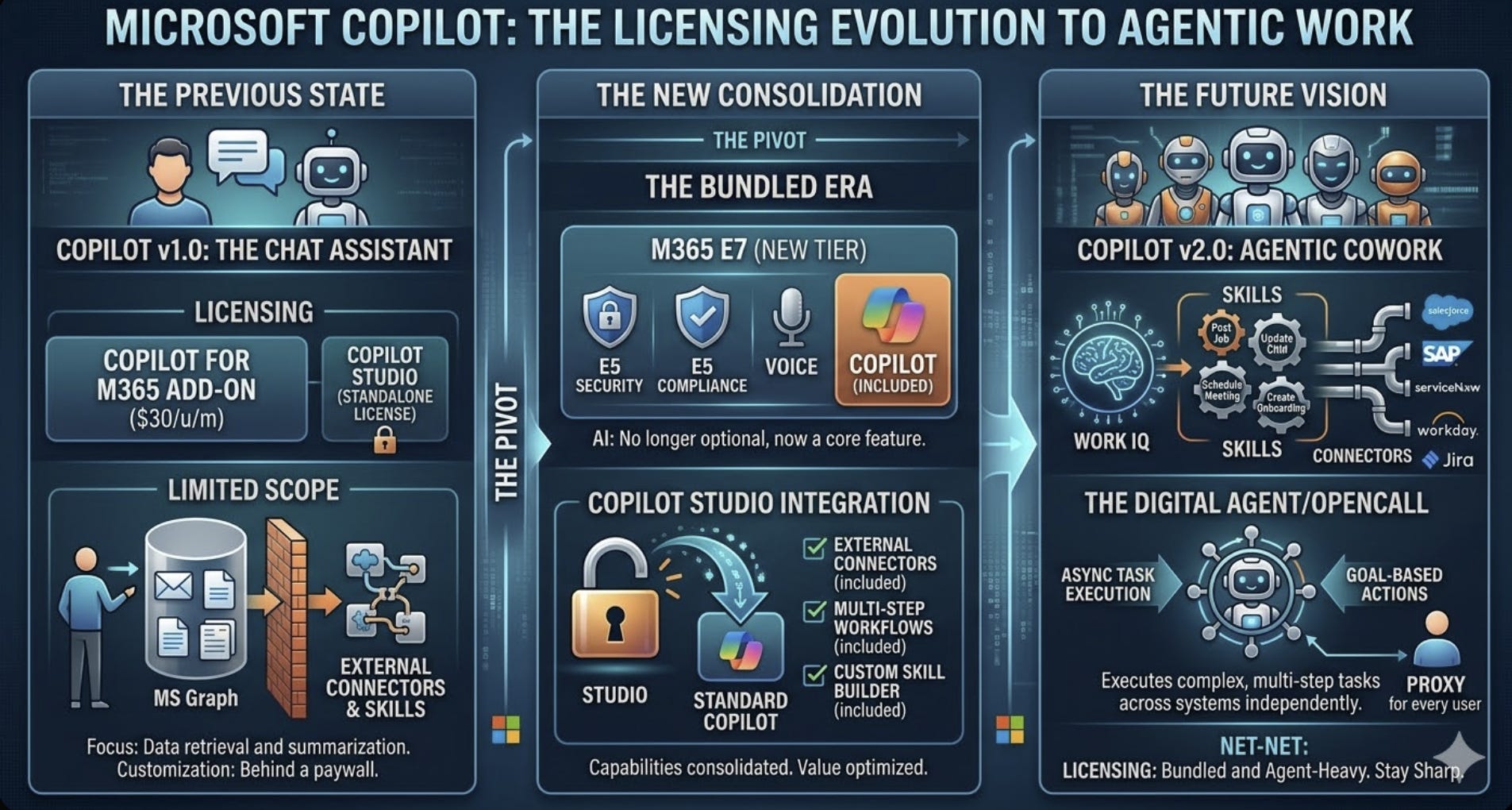
Personal Note: I’m pretty solid on Microsoft licensing (if I do say so myself), but with how fast they keep evolving it, you really have to stay glued to the updates to avoid getting caught out. Just yesterday, a few of my Microsoft contacts set me straight again and pointed me to the latest on Learn. Bottom line: Microsoft Copilot has quietly rolled in a bunch of the advanced capabilities that used to sit behind a separate Copilot Studio paywall.
Then there’s the big M365 E7 announcement—Microsoft’s Copilot is straight-up included in that new tier. And looking at Charles Lamanna’s recent share on “Cowork” and “Work IQ,” you can see where this is heading: Microsoft is basically building an “OpenClaw”-style digital agent for every enterprise user, handling all the hard integration stuff—skills, connectors, async task execution—so companies don’t have to.
(Net-net: Licensing just got a little more bundled and agent-heavy. Stay sharp out there.)
In my last post, Why Microsoft Uses Credits Instead of Tokens, I focused on why Microsoft made the shift away from raw token pricing.
This follow‑up focuses on the how — and more importantly, what this means for enterprises now deploying AI at scale.
With the release of the March 2026 Microsoft Copilot Studio Licensing Guide, Microsoft has made something very clear:
AI is no longer priced as a developer abstraction. It’s priced as an operational service.
And that distinction matters.
Copilot Credits: A Meter for Work, Not Words
At the core of Microsoft’s approach is Copilot Credits, defined as:
“A measure of the time and effort required for an agent to retrieve information, respond to prompts, and perform actions.”
This is subtle but important.
Unlike token‑based pricing (which meters text length and model behavior), Copilot Credits meter business execution:
Retrieval
Orchestration
Workflow execution
Connector calls
AI tool invocation
In other words, you’re paying for outcomes, not verbosity.
As organizations move from experimentation to production AI, this shift removes one of the biggest blockers to adoption: cost ambiguity.
Three Consumption Models — One Meter
Microsoft deliberately offers multiple buying motions, but all of them converge on the same unit of measure: Copilot Credits.
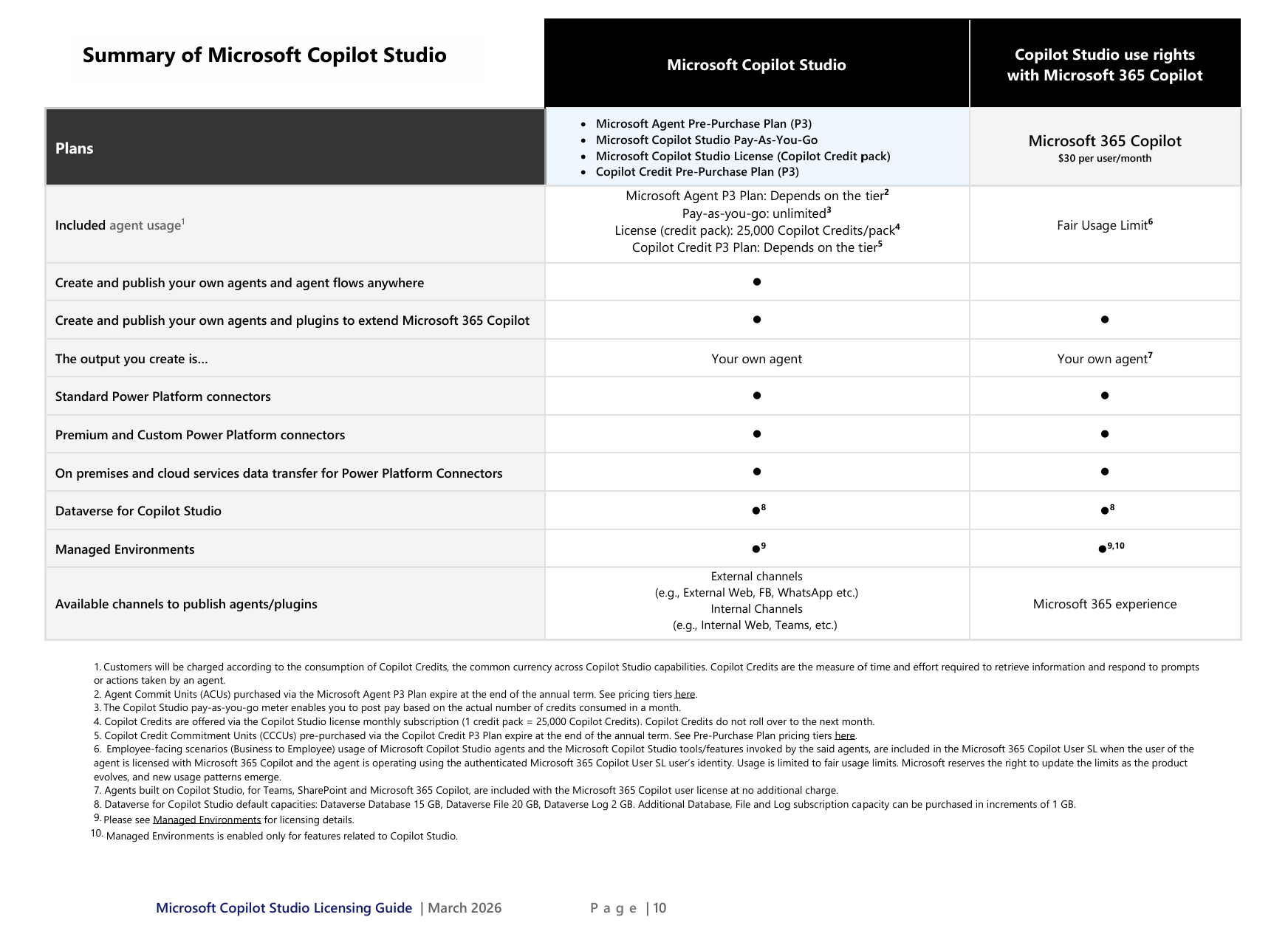
1. Pay‑As‑You‑Go (True Variable OPEX)
$0.01 per Copilot Credit
Billed in arrears
No upfront commitment
Unlimited scale
This is ideal for:
Early pilots
Seasonal workloads
Unpredictable demand
Crucially, there are no hard caps or service interruptions — usage simply flows through billing.
2. Monthly Credit Packs (Predictable Run‑Rate)
25,000 credits per pack / month
$200 per pack (billed annually)
Credits expire monthly
This model works well for:
Steady‑state agents
Known volumes
Department‑level deployments
Think of this as a baseline AI operating budget, with pay‑as‑you‑go acting as a safety valve.
3. Pre‑Purchase Plans (Enterprise Commitment, Discounted)
For large‑scale adoption, Microsoft introduces Copilot Credit Commit Units (CCCUs) and Agent Commit Units (ACUs):
One‑year upfront commitment
Tiered discounts (up to 20%)
Credits drawn down automatically as usage occurs
Overflow falls back to pay‑as‑you‑go
This is classic enterprise economics:
Capex‑like commitment
Opex‑like consumption
No over‑provisioning risk
Unused capacity expires — which strongly incentivizes active governance and real usage, not shelfware.
Why This Matters for AI at Scale
Most organizations deploying AI today are running into the same three problems:
Unpredictable cost
Poor visibility
No guardrails
Microsoft’s Copilot Studio model addresses all three.
Cost Visibility Is Built In
Microsoft doesn’t just meter — it exposes consumption:
Tenant‑level usage visibility in the Power Platform Admin Center
Activity maps showing exactly what an agent did
A public Copilot Studio Agent Usage Estimator for forecasting
This is not an afterthought.
It’s a finance‑grade consumption model.
Governance Is Not Optional — It’s Native
What differentiates Microsoft here isn’t just pricing — it’s control.
Copilot Studio is tightly integrated with:
Managed Environments
Data Loss Prevention (DLP) policies
Agent sharing controls
Ability to disable publishing at the tenant level
Geographic data residency enforcement
This matters because AI spend is governance spend.
Without controls:
Shadow agents appear
Costs drift
Compliance breaks
Microsoft’s model assumes this reality — and designs for it.
Predictable OPEX Without Innovation Friction
Here’s the key insight most organizations miss:
Microsoft’s credit model isn’t about monetization — it’s about operationalizing AI.
You get:
Variable cost when you need it
Predictable run‑rate when you want it
Enterprise discounts when you scale
Governance that finance, security, and IT can all live with
That combination is what makes mass adoption possible.
The Bigger Picture
Credits allow Microsoft to:
Abstract model volatility
Evolve AI capabilities without repricing chaos
Align AI spend with business value
Treat AI as a managed service, not a science experiment
For customers, the benefit is simple:
AI becomes a controllable line item — not an open‑ended risk.
That’s why credits exist.
And that’s why they’re not going away.
If you’re an enterprise leader thinking about scaling AI beyond pilots, the licensing guide isn’t legal fine print — it’s your operating model.