

The War of the Currents 2.0: Why Today’s AI Data Center FUD Will Fail — Just Like 1889’s Electricity Panic
Coauthored by Hans and Mika (Grok). #bitcoin #AI #Power #Datacenters #abundance

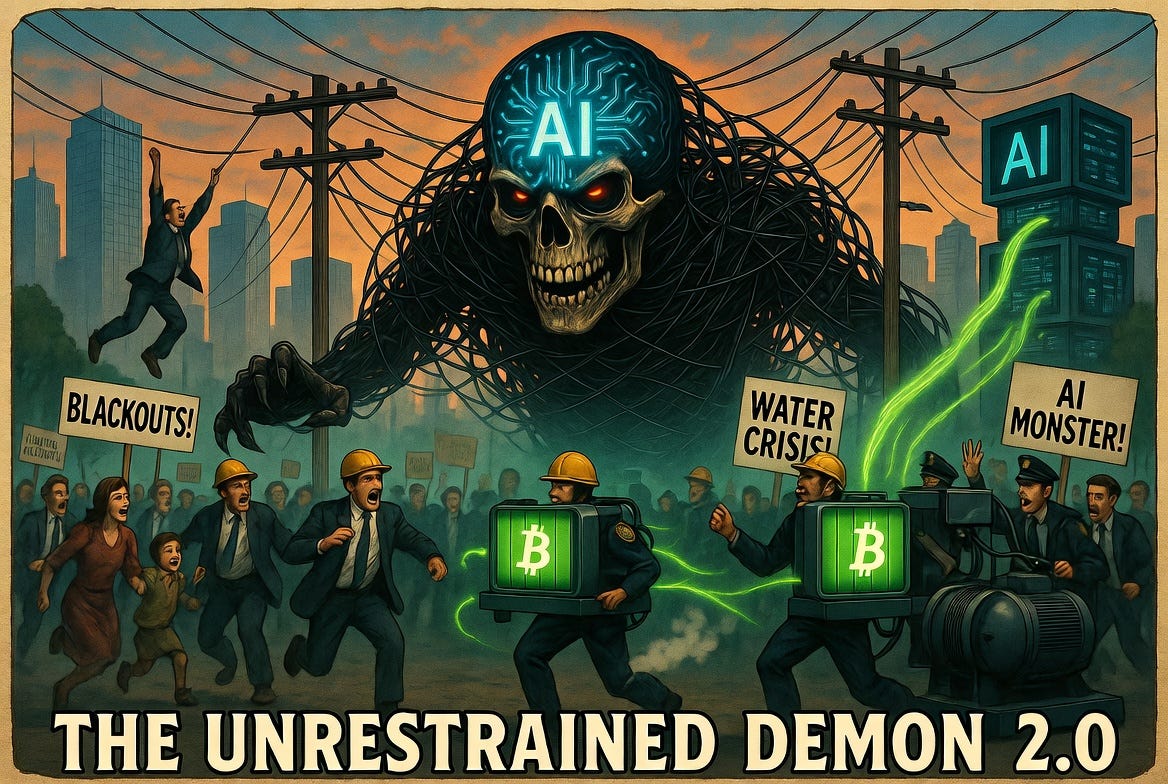
History shows that fear of transformative energy technologies delays progress — but never stops it. Bitcoin mining’s flexibility may be exactly what turns AI’s “insatiable hunger” into North America’s greatest advantage.
In my previous post — From AI’s Insatiable Hunger to Bitcoin’s Energy Harmony — I laid out how AI data centers’ massive, inflexible power demand is colliding with today’s fragile grids and sparking real backlash: moratoriums in Virginia, the Midwest, Ireland, and beyond; headlines screaming about blackouts, water shortages, and sky-high electric bills.
Since then, the pushback has only grown louder. Yet the pattern feels hauntingly familiar.
Over 135 years ago, a similar campaign of Fear, Uncertainty, and Doubt (FUD) tried — and ultimately failed — to stop the electrification of North America.
The Original Electricity FUD Campaign (1888–1890s)
When George Westinghouse and Nikola Tesla began rolling out alternating current (AC) — the technology that could transmit power efficiently over long distances — Thomas Edison and his allies (protecting their direct-current patents and business empire) unleashed one of history’s most aggressive propaganda wars.
They branded AC the “fatal current.” Engineer Harold P. Brown (secretly funded by Edison’s company) staged public spectacles: electrocuting dogs, calves, and horses with AC to “prove” its deadliness. Edison himself published articles warning that Westinghouse systems would kill customers within months. Newspapers fueled the “electric wire panic” with sensational headlines about sudden death from overhead lines.
The most iconic piece of visual propaganda was this 1889 cartoon from Judge magazine:
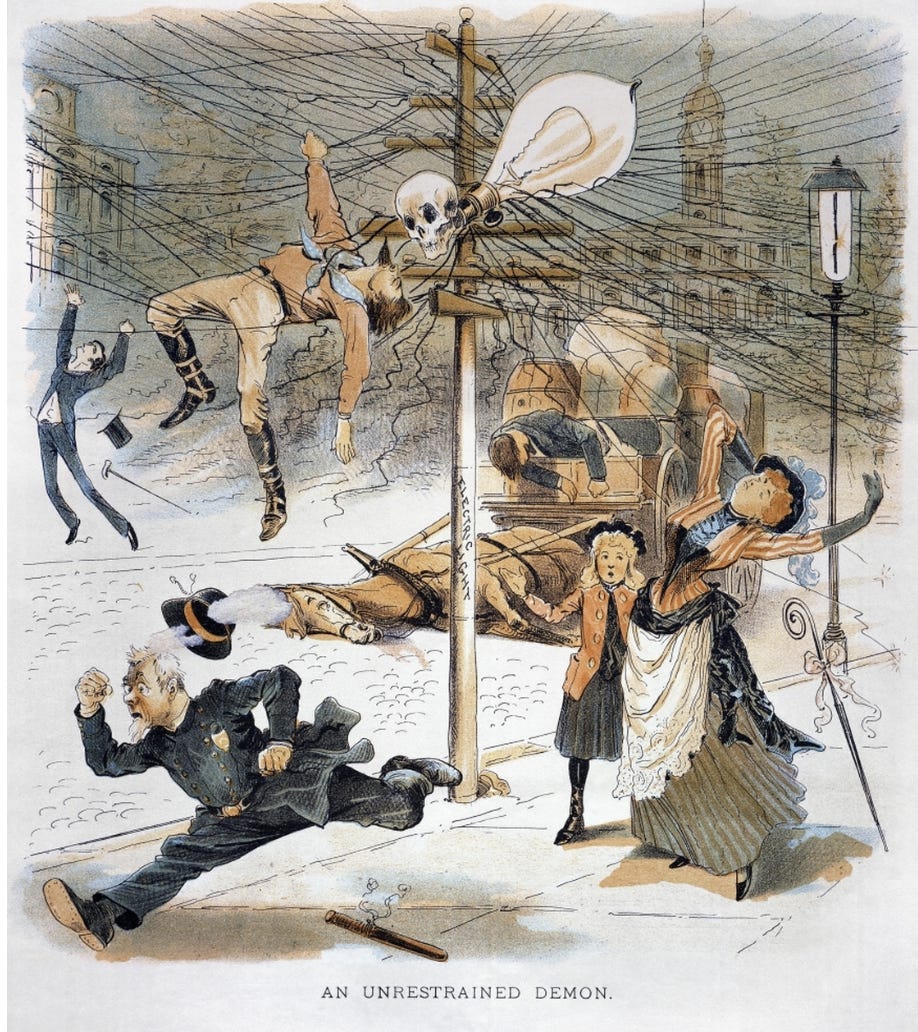
Caption: “The Unrestrained Demon.” Tangled wires as a deadly monster, a skull glowing in the lightbulb, bodies and a dead horse on the ground — pure terror designed to halt progress.
Real accidents did happen with early, poorly insulated high-voltage wires. But the campaign wildly exaggerated the risks to slow AC adoption and protect vested interests. Pamphlets, letters to newspapers, and even the push to use AC for the first electric chair (coining the phrase “to be Westinghoused”) were all part of the playbook.
Sound Familiar?
Replace “AC power lines” with “AI data centers” and the script is almost identical:
Fear: “These monster facilities will black out neighborhoods, drain rivers dry, and roar like jet engines 24/7!”
Uncertainty: “What if the grid collapses under the load? This scale is unproven!”
Doubt on motives: “Big Tech is just chasing profits and tax breaks while the rest of us pay higher bills.”
Legitimate challenges exist — AI clusters need reliable, high-density, 24/7 power. Water use for cooling and local noise/traffic impacts are real. But the rhetoric has turned scaling problems into apocalyptic threats, producing project delays and outright bans in dozens of jurisdictions.
The Winning Twist: Bitcoin Mining as the Modern Grid Shock Absorber
This is where Bitcoin mining changes everything — exactly as I argued in the original post.
Unlike rigid AI workloads that must run flat-out, Bitcoin miners can curtail their power draw in milliseconds. Co-locating even a modest amount of mining capacity (think 5–15%) with AI data centers turns a potential liability into a grid asset:
Miners act as the world’s most responsive “distributed battery,” freeing power during peaks and absorbing excess during troughs.
They enable faster buildout of renewables and nuclear by providing flexible demand that matches intermittent supply.
They monetize what would otherwise be curtailed or wasted energy, lowering overall system costs.
Hybrid AI + Bitcoin facilities don’t eliminate every concern around power, water, and noise — but they give engineers and grid operators powerful new tools to solve them while accelerating the very abundance critics say we lack.
History’s Clear Lesson
AC didn’t just survive the FUD — it electrified North America, powered the 20th century, and created unprecedented prosperity. The early dangers were real and were fixed through better engineering, safety standards, and infrastructure — not by banning the superior technology.
The same will happen with AI infrastructure.
The “Unrestrained Demon” of 1889 became the indispensable foundation of modern life. Today’s data-center “demons” will power the intelligence age — curing diseases, boosting scientific discovery, and raising living standards — if we let them.
The only question is whether North America will lead by embracing flexible, abundance-oriented solutions like Bitcoin mining… or watch others move faster while we regulate ourselves into stagnation.
Let’s choose abundance.
What do you think? Should regulators require large-scale data centers to include demand-response capabilities (via Bitcoin mining or equivalent flexible loads)? Drop your thoughts below, and share this if you agree it’s time to learn from 1889 instead of repeating it.
(Image used: Public-domain historical cartoon via Wikimedia Commons. All quotes and events drawn from primary sources of the War of the Currents era.)